Leave Your Message

What Is an Industrial Ice Machine?

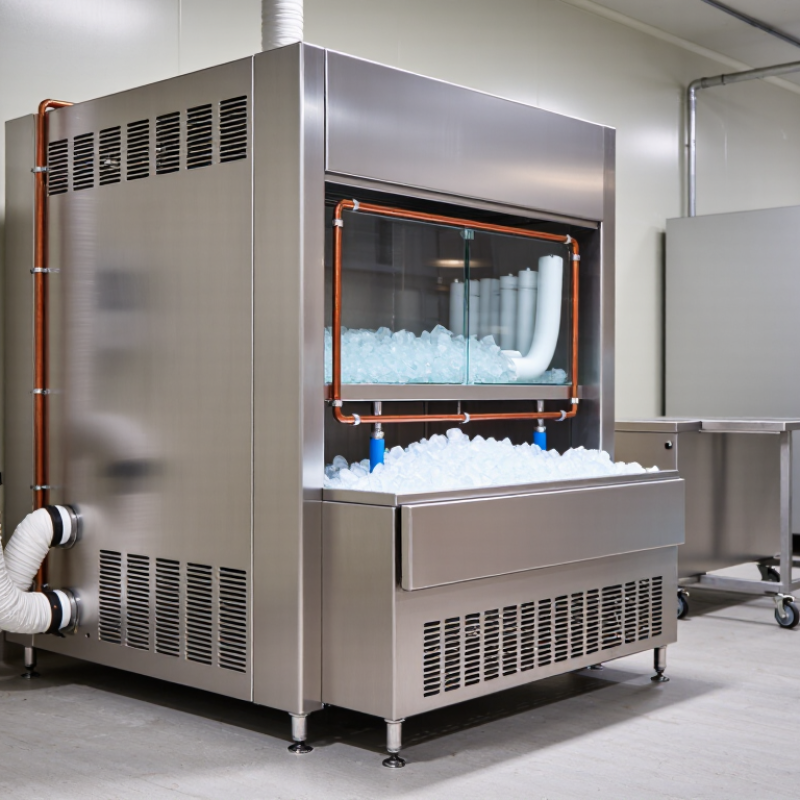
An Industrial Ice Machine is engineered to produce large, dependable volumes of ice for demanding commercial and industrial operations. It serves seafood processors, food manufacturers, concrete contractors, cold-storage facilities, and beverage plants. Unlike a small restaurant unit, it may operate continuously, often producing several tons of ice daily. The machine must manage water quality, refrigeration pressure, sanitation, heat rejection, and storage capacity at the same time.

A useful principle comes from Dr. John G. Stoecker, a respected refrigeration engineer and educator: “Refrigeration is the process of removing heat from a substance or space.” This simple statement explains the machine’s purpose. Water enters the freezing system, heat moves into the refrigerant, and finished ice leaves as flakes, tubes, plates, or blocks. The details matter. A seafood plant may need soft flake ice that surrounds fish gently. A concrete project may require accurately measured ice to control hydration temperatures. One machine cannot suit every application.

Capacity is not the only buying question. Energy use matters. So does cleaning access. So does the local water supply. Hard water can leave mineral scale on evaporator surfaces. Poor airflow can raise operating temperatures. These problems often appear slowly.

That is the uncomfortable part. A high-output Industrial Ice Machine is not automatically a good investment. It can waste energy when oversized or suffer downtime when maintenance is ignored. Buyers should compare tested production data, operating conditions, service support, and total ownership costs. Real performance depends on installation, habits, and honest measurements. The specification sheet is only the beginning.
What Is an Industrial Ice Machine?

Definition and Core Purpose of an Industrial Ice Machine

An industrial ice machine is a high-capacity refrigeration system that produces ice for commercial operations. Its core purpose is controlled cooling, not simple beverage chilling. Unlike a countertop unit, it supports continuous production, bulk storage, and demanding working conditions. Common formats include flake, tube, plate, and block ice. Each format transfers heat differently. That definition is useful, but incomplete.

The operating value becomes clear in seafood, food processing, concrete cooling, and distribution. FAO’s The State of World Fisheries and Aquaculture 2024 reported 185.4 million tonnes of global aquatic animal production in 2022. Seafood facilities use ice to slow temperature rise during handling and transport. UNEP’s Food Waste Index Report 2024 estimated 1.05 billion tonnes of food waste in 2022. Ice cannot solve waste alone, but reliable cooling can protect product quality during vulnerable hours.

Professional assessment should examine output, water quality, sanitation access, and energy demand. The ASHRAE Handbook—Refrigeration identifies entering-water temperature, condensing conditions, and system design as major performance factors. In practice, a larger machine is not automatically better. It may waste water, occupy valuable floor space, or operate below its efficient load. Operators should record daily production and reject rates. Small measurement gaps can become expensive habits.
What Is an Industrial Ice Machine?

An industrial ice machine is refrigeration equipment designed to remove heat from water and produce large, continuous quantities of ice for food processing, seafood preservation, concrete cooling, chemical processing, and cold-chain operations.

The chart shows the theoretical thermal energy that must be removed to produce 1,000 kg of ice when water enters at different temperatures. The calculation uses water’s specific heat capacity of approximately 4.186 kJ/kg·°C and the latent heat of fusion of ice at approximately 334 kJ/kg. Actual electrical consumption is higher because industrial refrigeration systems have compressor, condenser, evaporator, and heat-transfer losses.

Main Types of Industrial Ice Machines

What Is an Industrial Ice Machine?

Main Types of Industrial Ice Machines

An industrial ice machine produces large volumes of controlled ice for food processing, fishing, healthcare, and manufacturing. Unlike domestic units, it must operate continuously, tolerate demanding water conditions, and support strict hygiene routines. The 2024 FAO State of World Fisheries and Aquaculture report recorded 185 million tonnes of aquatic animal production in 2022. That scale explains the ongoing need for dependable cooling ice.

Flake ice is thin, soft, and easy to spread across fresh seafood. It melts quickly, so it provides close surface contact but needs frequent replenishment. Plate ice forms thicker sheets and offers longer holding performance during transport. Tube ice is harder and more uniform, making it useful for beverages, food displays, and process cooling. Block ice melts slowly and suits remote storage, although crushing requires extra labor.

Cube ice looks simple. It is not.

Ice selection depends on melt rate, storage space, water quality, and cleaning access. The 2022 ASHRAE Handbook—Refrigeration discusses ice production as a refrigeration application where evaporator design and operating conditions affect performance. In real facilities, operators may choose flake ice for seafood but later discover excessive meltwater on crowded floors. That is a practical weakness worth testing before purchase. Capacity figures also need careful reading. Rated output may change with ambient temperature, inlet-water temperature, and condenser maintenance. A reliable assessment should compare measured production, sanitation procedures, and energy use under actual working conditions.

What Is an Industrial Ice Machine? - Main Types of Industrial Ice Machines
Ice Machine Type Ice Form and Typical Characteristics Typical Production Capacity* Common Cooling Method Main Applications Key Advantages Important Considerations
Flake Ice Machine Produces thin, irregular ice flakes with a large surface area and relatively soft texture. Approximately 0.5–50 metric tons per day, depending on configuration. Air-cooled or water-cooled refrigeration systems. Seafood preservation, food processing, produce displays, concrete cooling, and bakery operations. Rapid cooling, excellent product contact, and easy distribution around irregular surfaces. Melts faster than larger ice forms and may require insulated storage and frequent replenishment.
Tube Ice Machine Creates hollow, cylindrical ice pieces with a relatively hard structure and consistent shape. Approximately 1–60 metric tons per day. Usually water-cooled or air-cooled refrigeration systems. Beverage service, food distribution, retail ice sales, and general cooling applications. Longer holding time than flake ice, good cooling performance, and convenient handling. Requires reliable water quality and periodic cleaning of the ice-forming tubes and water system.
Cube Ice Machine Produces solid, uniform cubes or cube-like pieces; dimensions vary by machine design. Approximately 0.5–20 metric tons per day. Air-cooled or water-cooled refrigeration systems. Restaurants, beverage production, hospitality, food displays, and packaged ice distribution. Clear appearance, predictable portioning, and comparatively slow melting. Cycle time, water filtration, sanitation, and storage-bin capacity affect overall output.
Plate Ice Machine Forms flat, relatively thick sheets of ice that are commonly broken into smaller pieces. Approximately 1–50 metric tons per day. Most commonly water-cooled; air-cooled designs are also available. Seafood processing, food transport, produce cooling, and industrial process cooling. Dense ice with good thermal capacity and a broad contact surface after crushing. Often needs a crusher or suitable handling system when smaller ice pieces are required.
Block Ice Machine Produces large, dense blocks that melt slowly and can be divided manually or mechanically. Approximately 1–100 metric tons per day, often using modular systems. Typically uses a brine tank or direct refrigeration system. Long-distance seafood transport, emergency cooling, food storage, and locations with limited power access. Very long holding time, strong thermal stability, and convenient bulk storage. Longer freezing cycles, higher handling weight, and additional labor or equipment for crushing.
Snow Ice Machine Produces soft, fine ice particles resembling snow, with high moldability and surface contact. Approximately 0.5–10 metric tons per day. Air-cooled or water-cooled refrigeration systems. Food presentation, seafood packing, medical and laboratory cooling, and specialty beverages. Excellent surface coverage, easy packing around products, and fast initial cooling. High surface area causes faster melting, so insulated storage and efficient delivery are important.
Crushed Ice System Uses a crusher to convert block, tube, cube, or plate ice into smaller pieces. Output depends on the connected ice maker and crusher throughput. Uses the refrigeration system of the primary ice-making unit. Seafood packing, food displays, beverage service, and rapid product chilling. Creates a flexible particle size and improves contact with products or containers. Crushing increases exposed surface area, which can accelerate melting and requires careful sanitation.
*Capacity note: The production ranges are indicative industrial ranges. Actual output varies with ambient temperature, water temperature, refrigerant system, ice thickness, operating schedule, and machine configuration. An industrial ice machine is a refrigeration system designed for continuous or high-volume ice production, typically combined with storage, conveying, filtration, and sanitation equipment.

How Industrial Ice Machines Work

An industrial ice machine turns treated water into controlled, repeatable ice for seafood, food processing, healthcare, and cooling logistics. FAO’s 2024 State of World Fisheries and Aquaculture reported 185 million tonnes of aquatic animals produced globally in 2022. That scale creates constant demand for dependable ice.

The process begins when a pump spreads water across a cold evaporator surface. A compressor raises the refrigerant’s pressure and temperature. The condenser then releases heat into air or cooling water. After expansion, the refrigerant becomes cold again and returns to the evaporator. Ice forms in layers, on plates, tubes, or a chilled drum, depending on the machine design. Sensors monitor water level, suction pressure, ice thickness, and storage capacity. During harvest, a brief hot-gas cycle or mechanical action loosens the ice. The ice falls into a bin.

Not perfectly every time.

ASHRAE’s 2023 Handbook—Refrigeration stresses correct refrigerant control, airflow, water quality, and heat rejection. The U.S. Department of Energy evaluates commercial ice equipment through energy-use measurements, commonly expressed as kilowatt-hours per 100 pounds of ice. A clean condenser can reduce wasted runtime, but real sites often overlook room temperature and drain design. That is where performance quietly declines.

Tips: Check incoming water hardness before selecting the evaporator. Clean scale regularly. Keep condenser air paths open. Record daily ice output, power use, and harvest time. These simple records reveal problems earlier than alarms. Do not assume a larger machine is better; oversized equipment may cycle poorly during low demand.

Key Components and Production Processes

What Is an Industrial Ice Machine?

Key Components and Production Processes

An industrial ice machine converts treated water into ice for food processing, fishing, healthcare, and cold-chain operations. Its main components include a water inlet, evaporator, compressor, condenser, expansion valve, and insulated storage bin. The evaporator forms ice on a chilled surface. The compressor circulates refrigerant through the system. The condenser releases collected heat into the surrounding air or water.

Production starts with filtration and controlled water distribution. Nozzle design matters because uneven flow creates thin or cloudy ice. During freezing, sensors monitor temperature and ice thickness. A harvesting cycle then releases the ice using warm refrigerant or mechanical movement. The finished ice may fall into a bin, where an agitator prevents large blocks from sticking together. Cleanable surfaces and accessible drains support safer operation. In practice, small design weaknesses can become expensive maintenance problems. This point deserves more attention.

Tips: Check water quality before installation. Inspect filters, seals, and drain lines regularly. Keep ventilation clear around air-cooled units. Record ice output and cycle time. Unexpected changes often reveal scaling, leaks, or sensor errors. Operators should also follow local food-safety requirements and the equipment maker’s maintenance instructions. A simple cleaning log helps verify consistent care.

Industrial Applications, Maintenance, and Safety Considerations

What Is an Industrial Ice Machine?

Industrial Applications, Maintenance, and Safety Considerations

An industrial ice machine produces large, consistent volumes of ice for food processing, fisheries, healthcare, concrete cooling, and beverage operations. Its design usually combines a water system, refrigeration circuit, insulated storage, and automated controls. Ice type matters. Flake ice cools fish quickly, while tube ice may suit processing and service areas.

Maintenance starts with water quality and airflow. Operators should inspect filters, pumps, spray bars, condenser coils, and drain lines on a documented schedule. Scale can reduce heat transfer and create uneven ice. Dust on condenser fins raises energy use. Keep records. They reveal gradual changes before production fails. A technician should verify refrigerant performance, electrical connections, sensors, and sanitation procedures. Cleaning frequency depends on water conditions and daily output, not only the calendar.

Safety requires more than a warning label. Lock out power before opening guarded areas or servicing moving parts. Use suitable gloves when handling sharp ice and cold surfaces. Floors near the machine need drainage and slip-resistant control. Stored ice must remain protected from chemicals, pests, and dirty tools. Never assume clear ice is clean ice. That is an easy mistake. Staff training should cover alarms, emergency stops, chemical handling, and restart checks. Rushed cleaning can create contamination risks, so supervisors should observe the work instead of relying only on signed forms.